Showing posts with label vocationalschool. Show all posts

Wednesday, April 9, 2014

Take a New Direction with MSC's Welding Program

Looking at a new direction of a better career? Check out the Maricopa Skill Center Welding program!

Welding is the process of joining together (metal pieces or parts) by heating the surfaces to the point of melting using a blowtorch, electric arc, or other means, and uniting them by pressing, hammering, etc. Students in the Welding program can learn various types of processes to prepare them for work in this industry.

Program details: 
Welding is a clock hour program; times for completion vary from 4 to 17.5 months depending on the number and type of processes certificates a student chooses. Day and night classes are available. Students are in class at least five hours a day, Monday-Friday.

What the students learn: 
MSC allows students a unique hands-on approach to learn the skills they will need to use in the welding industry. The program goes hand-in-hand by standards and practices outlined by the American Welding Society. Students have the opportunity to learn four welding processes.

TIG Welder
TIG welding process is where students learn to weld products made of alloys such as aluminum and stainless steel.

ARC Welder
ARC welding process is used to fit and tack metal on construction equipment, pipe systems, automobiles, ships, buildings and bridges.

FLUX-CORE Welder
Flux-Core welding is a process to fit and tack assemblies including construction equipment, pipe systems, ships, buildings, and bridges, using heavier materials.

MIG Welder
MIG welding will teach students how to weld any application using thinner and lighter materials in its construction.

Certificates:
Certificates can be earned in any combination of four processes in welding. Students can earn one certificate or can do a combination of two, three or four. There is also an opportunity if a student chooses to do a three combination of welding processes where they can elect to do an introduction into pipe welding. MSC only offers the intro to pipe welding when the student takes a three-process combination.

After graduation: 
Students can look forward to jobs in large or small shops, manufacturing facilities, marine and watercraft industries and construction sites.


Find out more! Call 602.238.4350. Visit the website.
Public tours are available 9:30 a.m. Tuesdays and Thursdays.

Tuesday, March 11, 2014

Take a New Direction with MSC's Meat Cutting Program


Looking for a new direction with your career? Check out the Maricopa Skill Center Meat Cutting program!  

Students can earn a certificate as an Apprentice Meat Cutter. The school has an open to the community Butcher Shop & Deli, which students are trained to work in.

Program details: 
Students are in class five hours a day Monday-Friday. It is approximately an eight month long course which costs approximately $4,412.00. Students must be 17.5-years-old to enroll and 18-years-old to work in the industry.

What the students learn:
Students learn how to process meat, pork and poultry while in the class and students are typically cutting their second day of class.
Students learn how to safely use and maintain hand tools and power equipment utilized in the meat cutting industry. Also, students learn how to identify, cut wrap, weigh and display all retail cuts for a meat case.
MSC’s Butcher Shop & Deli on campus provides students with an opportunity to gain hands on experience.

Butcher Shop & Deli:
The Butcher Shop & Deli is open to the community. The Shop is open during business hours Monday-Friday. Students fill the meat counter on Mondays.
The Butcher Shop will also process game. Students get hands on experience learning about processing game. No game is sold in the shop.
For more information, call 602-238-4374.

After graduation:
The students can look forward to careers as a retail meat cutter, retail meat wrapper, wholesale meat cutter or a meat and deli counterperson. Salaries range from $11.96 to $21.39.

Next program start dates: 
May 5th (Must be enrolled and have taken assessment by March 24th)
June 2nd (Must be enrolled and have taken assessment by April 21st)

Other Certificate Option:
MSC is also home to a Meat Department Helper certificate. The certificate will allow students to assist meat cutters by preparing the meats to be cut; trimming and packaging cuts for retail; stocking, rotating and maintaining meat cases.
Students must be 17.5-years-old to enroll and 18-years-old to work in the industry. The certificate takes about 4 and half months to complete with an estimated cost of $2,548.00.

Find out more! Call 602.238.4350. Visit the website
Public tours are available 9:30 a.m. Tuesdays and Thursdays.

Thursday, February 6, 2014

Take a New Direction with MSC's Computer Support Specialist Program

Looking for a new direction with your career? Check out the Maricopa Skill Center Computer Support Specialist program!  

Students in the Computer Support Specialist program learn how to repair and build computers. By the end of the course, students will build a fully functioning computer that is theirs at the completion of the Computer Support Specialist certificate.  

Program details: 
Students are in class for at least five hours a day, Monday-Friday. It is an 800-clock hour program that takes approximately eight months to complete.

What the students learn:
When students first enter the course they learn basic theory and computer support techniques.
They learn the parts of the computer, assembly and trouble shooting.
Next, students move to operating systems. Windows operating systems are learned, including, Vista, XP, Windows 7 and some Windows 8.
After operating systems, students learn about networking for home and business.
Students then also learn about security, servers and e-mail.

Where the parts come from:
Arizona StRUT supplies the school with the majority of the computers and parts that the students get to work with hands on. Once the computers are repaired they are given back to StRUT who gives to schools and non-profits in the community.
The school also gets donations from the public. The public is welcome to bring in their computers to be fixed. If interested in donating, contact 602-292-5261.

A+ Certification:
CompTIA A+ Certification is the industry standard for entry-level positions. The certification is included in the course.

Exciting changes ahead:
The computer support program will be changing in July to a cohort system where students start the program together and will end at the same time. The program will be approximately nine and a quarter months long.
Along with that change, a new curriculum is being adopted. The program will be following a Cisco System curriculum. With the new curriculum mobile devices will be covered more. Also, a customer service aspect will be added. Student will also then take the Cisco A+ certification instead of CompTIA A+.

After graduation:
The students can look forward to jobs as computer support specialists, network technicians, PC repair technicians, helpdesk technicians and tech support representatives.

Next program start dates: 
Students can enroll for starting in March. The next start date is in July.

Find out more! 
Call 602.238.4350. Visit the website
Public tours are available 9:30 a.m. Tuesdays and Thursdays.


Thursday, January 23, 2014

Take a New Direction with MSC's Auto Body Program

Looking for a new direction with your career? Check out the Maricopa Skill Center Auto Body program!  

This January an exciting new enrollment plan launched for the Auto Body program at MSC. Students are now moving through the Auto Body Basic Metal Repair and Refinishing certificate program as a cohort. The students will finish the program in mid August.

Program details: 
Students are in class from 8 a.m.-2:30 p.m. Monday-Thursday. It is a 1011 clock hour program that takes approximately eight months to complete.

What students learn while in the cohort:
Students first have essentials for auto body and then move onto Occupational Safety and Health Administration standards for auto body.
Next is the Introduction to Repair. Students learn MIG welding, paint-less dent removal and plastic bumper repair. Students learn how to repair 3 panels and one plastic bumper during their time in introduction.
After that, there is Introduction to Refinishing. The students paint the panels they repaired in the Introduction to Repair. Once painted, students learn detailing of vehicles.

Students then move to Auto Body Metal Repair where they learn frame repair and using a frame alignment machine. Students are required to work on one vehicle to finish the section of the course. Students’ personal vehicles can be worked on or they can team up with a classmate who has one.
To finish the program, students then move onto Auto Body Refinishing and they are required to refinish the vehicle they repaired.

I-CAR Certification:
All students have to pass Inter-Industry Conference on Auto Collision Repair certification exam before graduation. I-CAR is an international organization dedicated to the training in collision repair. The certification helps the student look more marketable when applying for jobs. The students complete a total of 14 tests to get certified. All tests are taken online and at the students convenience.

After graduation:
The students can look forward to apprentice level jobs as painters or metal repair in shops.

Next program start dates: 
May 5 (Must be enrolled and have taken assessment by March 10th)
July 7 (Must be enrolled and have taken assessment by May 19th)
Aug. 25 (Must be enrolled and have taken assessment by June 30th)

Find out more! Call 602.238.4350. Visit the websitePublic tours are available 9:30 a.m. Tuesdays and Thursdays.

Wednesday, January 8, 2014

Take a New Direction with MSC's Aesthetician Program


Looking at a new direction of a better career? Check out the Maricopa Skill Center Aesthetician program!

What is an aesthetician? An aesthetician is someone who specializes in skin care.

What do aestheticians do? Facials, waxing and makeup are some of the services aestheticians provide.

Where do aesthetician work? Some prospective jobs in aesthetics are at day spas, medical spas, resorts, salons and private practices. Aestheticians can specialize in skin conditions; for example, acne, aging and rosacea. 

What are the requirements to practice aesthetics? Practitioners have passed a state board and received an aesthetician license. The state board exam consists of a 100 question written test and hands on demonstrations.

Aesthetician Program at MSC: 
Students are in school 8:30 a.m.-2 p.m. Monday-Friday. The first half of the day consists of lecture and textbook work. The second half of the day is hands on experience. Students perform the skills learned on mannequins and fellow students. After 16 weeks students move to a clinic setting. 

What students learn: 
Students first learn sanitation and work station set up. Sanitation is the number one priority for the Arizona Board of Cosmetology and very important for the board exam.
Students then move into the basics of a facial. Steps to a facial, the building blocks and protocols like consultation, exfoliation and extraction are learned. Advanced protocols are learned as the course goes on. Students get to hone in on certain techniques as they progress. For example, facial message techniques are something students continue to work on.
After basics are learned students also move onto learn the machines used in facials. Some machines learned are microdermabrasion, ultrasound and high frequency.
Waxing is the next step for students. About a week is spent on each soft and hard wax. After completing this section students usually have a waxing day once a week to continue building skills.
Back treatments are learned next. Students learn how to do mud and body wraps.
Makeup is the final section learned for students. Day, evening and special occasion makeup is taught.
Throughout the course students learn about ingredients and product education to ensure they know what ingredients can be most beneficial to a client. Also throughout the program, students learn the art of retail for aesthetics. Students learn about how to provide customers with the best products for at home use.
“We help you build the foundation of aesthetics,” said Aesthetics Instructor Shala Dveirin.

The Clinic:
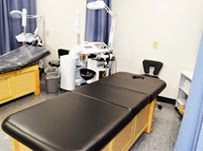
After students have completed the first 16 weeks they move to the clinic setting. The school has a salon open to the public. Students in the clinic setting provide facials, waxing, makeup and back treatments to clients. Instructors supervise and receive feed back from clients to make sure students are providing adequate service.
“We want them to go out confidently into the industry,” Shala said. “Everyone comes out ready for state boards.”

Next program start dates: March 24, May 12
*Enrollment & Fiancial Aid process needs to be started approximately six weeks prior to course starting.

Program details: It is a 630 credit hour program that takes approximately six months to complete. Students spend 25 hours a week in the classroom. Estimated cost: $3,882.00. The program is offered at MSC, 1245 E. Buckeye Road, and the Northwest campus, 2931 W. Bell Road.

Find out more! Call MSC 602.238.4350; Northwest Campus 602.392.5000. Visit the aesthetician website
Public tours are available 9:30 a.m. Tuesdays and Thursdays. 


Wednesday, March 20, 2013

Program of the Week: Auto Body

Auto Body Refinishing 

We drive to school. We drive to work. We drive back home. We do it again the next day, everyday. Many of us take driving for granted that we don't realize how much sun exposure is damaging our car's paint job. Luckily, there's a way to refinish and fix the outer appearance of your car.


Students from the Auto Body Program at the Maricopa Skill Center demonstrate how to do a solid paint job in auto body refinishing. 
Auto Body garage at Maricopa Skill Center.
Preparation
Students remove and disassemble all parts to a car. After they are all taken down, students use soap and wax grease remover to clean all parts.

All parts and panels removed from a '03 Chevy Malibu.
Rust
Once all the parts are cleaned, a 40-Grit Sandpaper is used to strip down the paint. An 80-Grit Sandpaper is then used to take out all rusted areas. Once the rusted areas are smoothed out it is ready for masking application.

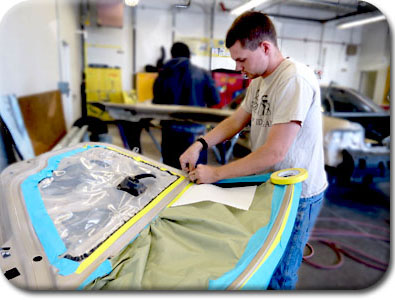
Clayton Cluff masks a door panel before applying primer.
Masking
Yellow tape is used for masking, which helps prevent paint from bleeding underneath. After all areas are carefully masked, the next step is to apply Etch primer.

Primer
Etch primer and primer is then applied to give the best protection to the metal. After the primer dries, wet sanding is done to help the paint adhere to the metal.

Paint
The next step is to reassemble all the parts and panels back together. The car is then driven to the paint booth where students spray base coat. After the base coat dries, three coats of the original paint are sprayed. After a few days of drying, three coats of clear are then sprayed.


Buff
After the clear coats dry, wet sanding is done again to sand out any other imperfections of the paint job. The car is then buffed and polished. 

Manuel Ortiz buffs the hood of a '93 Honda Prelude.
So there you have it! It may sound easy, but think again. This whole process takes a lot of time and skill to finish and MSC students got it under control. 

Stay tuned for next week's program spotlight: Health Care!