Wednesday, April 17, 2013

Program of the Week: Meat Cutting

Apprentice Meat Cutter


Packaged retail meats in the Butcher Shop & Deli at Maricopa Skill Center.

Imagine wearing winter clothes all year-round in Arizona. In fact, none of us would survive especially in the middle of July! But, in the Meat Cutting Program at Maricopa Skill Center (MSC), students wear jackets and beanies to keep themselves warm. The average temperature inside the meat cutting room is set at approximately 30-40ºF to maintain proper sanitation.

Diagram of Beef Primal Cuts
MSC's Meat Cutting Program receives domestic orders from vendors, which arrive in large, divided sections called primal cuts (as shown in the diagram). The students process and handle these primal cuts into individual retail cuts.

Students in the Meat Cutting Program demonstrate proper steps in preparing beef ribs and beef top sirloin for merchandising a retail meat case and for filling customer orders. 
_____________________________________________________________________

Beef Ribs


Step 1: A section of the beef rib area is carefully placed under a band saw to slice each piece.


Step 2: After each beef rib is sliced, the piece is examined to see if there is any bone dust, which is removed by a scraper.


Step 3: Any excess fat is trimmed using a 6-inch boning knife.


Step 4: A tray and clear wrap is used to package each beef rib.


Step 5: After the trays are sealed and labeled, they are merchandised in a retail meat case.
 _____________________________________________________________________

Beef Top Sirloin


Step 1: Each beef top sirloin is cut into any thickness the customer desires. The knife used to cut this is a 12-inch steak knife.


Step 2: This measuring tool was actually custom-made from the Precision Machining Program at GateWay Community College. It is used to accurately slice the thickness of the meat in different measurements.


Step 3: The beef top sirloin pieces are packaged in a freezer wrapping paper.


Step 4: The packages are then boxed up and ready for customers to pick up.


 _____________________________________________________________________


Butcher Shop & Deli at MSC.

As you can see, there are interesting steps that goes along processing and handling different types of meats. The next time you're shopping at the grocery store, you'll know exactly what's going on behind the counter in the meat cutting room.

Stay tuned for the next blog spotlight: Construction Trades!

Wednesday, April 3, 2013

Program of the Week: Health Care

Ophthalmic Assistant Training

Do you remember the moment where the sign across the street appeared blurry to you? Did you force yourself to squint so hard just so you can read what the words were saying? If so, you should probably make an appointment for an eye exam ASAP!

So, what can you expect in an eye exam?

Students from the Ophthalmic Assistant Program at the Maricopa Skill Center demonstrate the process of a preliminary eye exam that is completed before meeting with an ophthalmologist.

Kerotometer in the Ophthalmic classroom at the Maricopa Skill Center.

Medical History
The patient is asked if there are any known medical histories that could include complaints, allergic reactions, medications, diabetes, injuries, and surgeries. 

Visual Acuity Test
This test is done to measure the sharpness of the patient's vision. He/she holds the occluder to cover one eye at a time while reading a Snellen chart or the near vision card. 

MSC students assist one another through a preliminary eye exam. 
Visual Field Test
The patient is tested to see if he/she is able to see if they have peripheral vision around their visual field. This tests for any early signs of glaucoma, which is an eye disease where the nerve in the back of the eye is damaged.

Extraocular Muscles

This test examines the patient's eye muscles, which is identified as extraocular muscles. This is done using two fingers to make an "H" pattern to check that all muscles are intact. 


Pupil Constriction
A pen light is directed towards the patient's eyes to check if it shrinks (constriction). The light is pointed directly at one eye at a time to see if the other eye reacts equally. When light is flashed at one eye, both pupils should constrict.
 
Instructor Pat Lamb (left) shows how a direct ophthalmoscope is used.

Other Eye Tests
There are other tests that are done while using different instruments to examine the inner eye. Instruments include a tonometer, a direct ophthalmoscope, or  a slit lamp that's mounted on an exam chair.

Tonometer
This is used to measure inocular pressure, which is the inside pressure of the eyes. If there is pressure it may indicate the beginning causes of glaucoma.


Direct Ophthalmoscope
This is a magnified tool that is used to examine the retina, which is a thin tissue layer of the back of the eye. It has a mirror where a blue light reflects into the eye.

Hand-held Slit Lamp
This lamp is also known as a biomicroscope. Before this test is done, orange drops with fluorescein are put into the white area of the eye to indicate any scratches in the surface of the eye. This examines the cornea, iris, pupil, lens, lashes, and lids.

Pat Lamb assists Ophthalmic students how to use a tonometer and a direct ophthalmoscope.

As you can see, getting an eye exam simply doesn't mean you're going in to get prescription eyeglasses or contact lens. Your eyes are being checked for eye disease and overall health!

Stay tuned for next week's program spotlight: Meat Cutting!

Wednesday, March 20, 2013

Program of the Week: Auto Body

Auto Body Refinishing 

We drive to school. We drive to work. We drive back home. We do it again the next day, everyday. Many of us take driving for granted that we don't realize how much sun exposure is damaging our car's paint job. Luckily, there's a way to refinish and fix the outer appearance of your car.


Students from the Auto Body Program at the Maricopa Skill Center demonstrate how to do a solid paint job in auto body refinishing. 
Auto Body garage at Maricopa Skill Center.
Preparation
Students remove and disassemble all parts to a car. After they are all taken down, students use soap and wax grease remover to clean all parts.

All parts and panels removed from a '03 Chevy Malibu.
Rust
Once all the parts are cleaned, a 40-Grit Sandpaper is used to strip down the paint. An 80-Grit Sandpaper is then used to take out all rusted areas. Once the rusted areas are smoothed out it is ready for masking application.

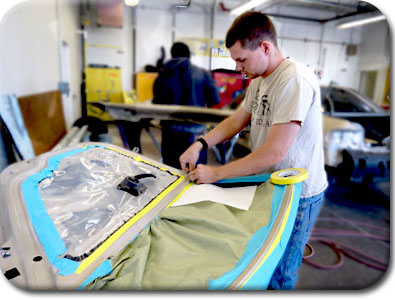
Clayton Cluff masks a door panel before applying primer.
Masking
Yellow tape is used for masking, which helps prevent paint from bleeding underneath. After all areas are carefully masked, the next step is to apply Etch primer.

Primer
Etch primer and primer is then applied to give the best protection to the metal. After the primer dries, wet sanding is done to help the paint adhere to the metal.

Paint
The next step is to reassemble all the parts and panels back together. The car is then driven to the paint booth where students spray base coat. After the base coat dries, three coats of the original paint are sprayed. After a few days of drying, three coats of clear are then sprayed.


Buff
After the clear coats dry, wet sanding is done again to sand out any other imperfections of the paint job. The car is then buffed and polished. 

Manuel Ortiz buffs the hood of a '93 Honda Prelude.
So there you have it! It may sound easy, but think again. This whole process takes a lot of time and skill to finish and MSC students got it under control. 

Stay tuned for next week's program spotlight: Health Care!

Wednesday, March 13, 2013

Program of the Week: Cosmetology

How To: Trim and Style Hair

Hair is known to be worth great value. Whether it's short, long, dark or light, hair is the biggest identity of a person. It is also the most purest form of protein in the world, which provides the brain vitamin D, energy, phosphorus, and metals.

From the Cosmetology Program at Maricopa Skill Center, student Shayquan Hollman aka Say Say, demonstrates a perfect method in maintaining a client's hair by trimming and styling it.
Shayquan Hollman (left) and Tonya Norwood after a complete hair trimming and styling.
 
Items Needed:
Shampoo and Conditioner
Olive Moisturizing Sheen Spray
Hair Dryer
Comb
Hair Clips
Flat Iron Protection
Thermal Styling Spray
Flat Iron
Hair Cutting Sheers
Hair and Scalp Conditioner 

1. Say Say first assists Tonya to the shampoo bowl to give her a good hair wash using shampoo and conditioner.


 2. After drying from the towel, Say Say sprays Olive Moisturizing Sheen Spray as a heat protectant before blow-drying Tonya's hair.


3. In order to dry her hair completely, Say Say parts each section with a hair clip. She then points the blow dryer down her hair with constant movements. 


4. After drying Tonya's hair, Say Say sprays a Flat Iron Protectant and a Thermal Styling Spray. Since Tonya's hair is coarse, it is crucial to straighten her hair with a hot iron so it can be combed into place with the ends lining up neatly when being cut.


5. Elaine Balderas, Cosmetology Instructor, guides Say Say in the most successful methods in hair-trimming.


6. Elaine presents the complete hair-trimming.


7. As a final touch, Say Say applies Hair and Scalp Conditioner before curling the ends of Tonya's hair to give her a voluminous look.


Voilà!


Stay tuned for next week's program spotlight: Auto Body!

Friday, January 11, 2013

Happy New Year!

Last year flew by and we are now on day 11 of the New Year. As we forge ahead into 2013, let's take a quick look at our last couple of weeks in 2012!

MSC became very festive before the winter break. It's hard getting into the holiday spirit while working (whether on the job or in class) but holiday decorations will definitely do the trick.


Students and staff had a jolly good time enjoying cookies and hot chocolate, listening to holiday music, and playing Wii and XBox. There was dancing to Michael Jackson and adventure games that included being in a raft while jumping over tree branches. Thanks to all of our outgoing and brave gamers who entertained the rest of us who were too shy to play.


Not only did we play at MSC, we also gave back. Two of our Cosmetology students, Ruby Guzman and Vanessa Ballastero, organized a toy drive for sick children. Those that donated were able to receive a free salon service. Ruby and Vanessa originally decided to give the toys to a local children's hospital, but after realizing that the hospital didn't have a need for more toys, they delivered 80 toys to Maricopa County Hospital.

Students Ruby Guzman (left) and Vanessa Ballastero organized a toy drive to benefit sick children.
Vanessa said that the staff and children were very excited to receive the toys. "The nurses were so happy that they were crying. Ruby and I went door-to-door delivering toys to the children. It was a great experience."

2012 was filled with many great experiences for MSC - a 50th anniversary celebration, new programs, the completion of a campus remodel that led to a huge grand reopening, and of course, new students filling the halls.

It was a wonderful year at MSC and we're looking forward to 2013. Hope it's off to a great start for you!

Wednesday, December 12, 2012

Making Solid Changes: Farewell

--FAREWELL--


Thanks for sharing this journey with us! You’ve seen our major campus overhaul from beginning to end and everything in between. We appreciate your support. And if you weren’t able to attend our Grand Reopening Block Party, then please attend one of our public tours held Tuesdays and Thursdays at 9:30 a.m. This is the end of the blog, but you can always find MSC on Facebook, Twitter, and YouTube!


Friday, November 30, 2012

Making Solid Changes: The Final Countdown Part III

-- THE FINAL COUNTDOWN --


For our second-to-last blog post, why not have a party?! MSC opened the campus to the general public on Nov. 2 to help us celebrate our Grand Re-opening and 50th Anniversary. We had face painting, live music, dancing, campus tours, food (Satay Hut and Sandra Dee's) … And most important, we all had a blast! Take a look! 

Getting the party started ... dance time!
Local businesses, nonprofits, social service organizations, and MSC staff and students manned tables. Even some of the armed forces, 104.7 KISS FM and the reigning Ms. Phoenix came out to celebrate with MSC.


MSC students and staff painted faces, explained computer support and health care.

Thanks to everyone who celebrated with us! MSC is looking forward to another great 50 years!